

An attorney can be excellent at practicing law and still have no idea how to open a law firm. Those are two entirely different skill sets, and nobody teaches the second one in law school.
This is a composite case study drawn from real engagements establishing single practitioner law firms in Lee County Florida. Details have been anonymized and combined; the sequence, the decisions, and the tradeoffs are real.
Key Takeaways
- Practice management software should be chosen against the best billing model for your practice, not against feature-count comparison charts.
- Proper trust accounting is the one system you cannot fix later. Set up IOTA correctly on day one.
- The office buildout and the technology buildout compete for the same 60 days. Sequence them, don’t parallel them blindly.
- Choosing Microsoft 365 or Google Workspace is a document-management decision, not just an email decision.
The Situation
The client was a family law attorney leaving a mid-size Fort Myers firm to open a solo practice — a textbook solo law firm setup situation, right down to the compressed timeline. She had a book of business willing to follow her, a signed lease on raw office space, and roughly 60 days before her malpractice coverage and her first hearing date collided.
What she did not have: a case management system, a trust account, a phone number, a chart of accounts, furniture, or a way to accept a retainer.
She also planned to run three billing models simultaneously — hourly for contested matters, flat fee for uncontested dissolutions and simple modifications, and a small contingency component on a handful of collections-adjacent matters. That combination narrowed the software field considerably.
Choosing the Practice Management System
Most attorneys start their practice management decision process by reading review sites. That is backwards. The right starting point is diagramming how money will move through the firm.
We ran a structured evaluation across five platforms the client had heard of or inherited exposure to — the same evaluation we run for every solo law firm project, regardless of practice area:
Clio — Strongest Florida trust accounting workflow and the deepest integration ecosystem. Clio Manage plus Clio Accounting handled three-way reconciliation cleanly and synced to QuickBooks Online without a middleware layer.
PracticePanther — Competitive automation and a lower price point. Flat fee and payment plan handling is genuinely good. Reporting depth was thinner than the client wanted for year-two planning.
MyCase — Excellent client portal and the friendliest interface of the group. Attractive for a firm that expects heavy client communication, which family law is. Trust accounting is capable but less granular.
Amicus Attorney — Strong matter-centric design with a long practitioner following. The desktop lineage matters: it fits firms with an existing server and on-premise habits better than a firm starting from nothing.
PCLaw — The most accounting-forward option of the five, with general ledger functionality built in rather than bolted on. Better suited to firms with a bookkeeper on staff than to a solo who wants to hand a clean file to a CPA.
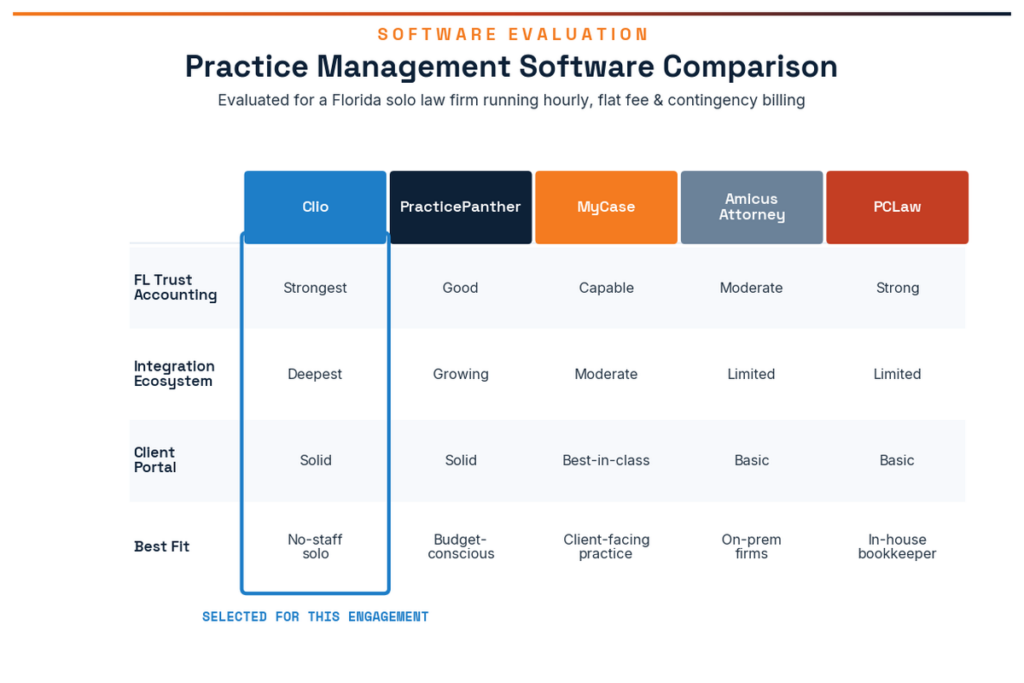
We selected Clio for this engagement. The deciding factors were Florida Bar trust compliance depth, the QuickBooks Online sync, and the fact that a solo with no staff needs the vendor ecosystem to do the integration work she can’t.
Important caveat: this was the right answer for this firm. A plaintiff’s personal injury solo running pure contingency would likely land somewhere else entirely. There is no universally correct platform.
Configuring for Three Billing Models
Hourly work required activity codes, billing increments, matter-level rate overrides, and an invoice template that survived client scrutiny.
Flat fee work required package definitions, milestone-triggered invoicing, and — critically — a clear rule for when flat fee funds move from trust to operating. That rule was written down before the first client was billed, because Rule 4-1.5(e) and Rule 5-1.1 do not forgive improvisation.
Contingency matters required cost advancement tracking and a settlement disbursement worksheet so that fee, costs, liens, and client proceeds reconcile before anything is disbursed.
Trust Accounting and the IOTA Account
This is the section attorneys skim and then regret skimming.
We opened the IOTA account at a Florida Bar-eligible institution, configured the operating account alongside it, and built the three-way reconciliation process — bank statement, book balance, and the sum of individual client ledgers — as a monthly calendar obligation with a named backup.
Individual client ledgers were configured inside Clio so that no client balance can go negative without the system objecting. Every trust transaction requires a matter association. There is no “miscellaneous” trust category, because that category is how attorneys get disbarred.
QuickBooks Online was set up with a law-firm chart of accounts that keeps trust liability, operating revenue, and advanced client costs in separate, non-comingled places, then synced to Clio one direction only to avoid duplicate entries.
Microsoft 365 vs. Google Workspace
The client assumed this was an email decision. It isn’t. Email is the least interesting part.
We deployed Microsoft 365 Business Premium for three reasons specific to her practice:
Document handling. Family law runs on Word documents with tracked changes moving between opposing counsel. Real Word, not a conversion layer.
SharePoint matter structure. Matter-based document libraries mirroring the Clio matter numbering, so the file location is predictable without thinking about it.
Compliance posture. Multi-factor authentication, conditional access, retention policy, and litigation hold available without a bolt-on product — which matters for Rule 4-1.6 confidentiality obligations.
Google Workspace remains the better call for firms that live in browser-native collaboration and have no heavy document-exchange requirement. It was not this firm.
Phone System
A cloud phone system with a Fort Myers local number, an auto-attendant, voicemail-to-email transcription, and a mobile app so the client could take a call from a courthouse hallway without publishing her cell number.
Call routing rules were built around a hearing schedule, not a 9-to-5 assumption. That single design choice is what makes a solo sound staffed.
Office Buildout
Raw space became a working office in under seven weeks: layout for a reception area, a private consultation room with actual sound isolation, and a work area; structured cabling before furniture arrived; access control; and ADA-conscious circulation.
Sound isolation is the item most solos underspend on and most regret. Family law clients say things in a consultation room that cannot be audible in a waiting area.
Payroll and Administrative Infrastructure
Payroll was enrolled before the first paralegal was hired rather than after — Florida reemployment tax registration, workers’ compensation, and direct deposit configured in advance so onboarding was a two-day task instead of a two-week scramble.
Conflict checking, document retention, engagement letter templates, and a backup verification schedule rounded out the administrative layer.
Outcome
The firm opened on schedule and took its first retainer through the client portal in the opening week.
Six months in: trust reconciliation had run clean every month, the practice had added a paralegal onto the existing system without reconfiguration, and this solo Lee County attorney was spending her time on matters rather than on infrastructure.
The measurable win is not a revenue number. It’s that nothing had to be rebuilt.
Frequently Asked Questions
How long does it realistically take to set up a solo law firm in Florida?
Sixty to ninety days is achievable if the office lease and the technology decisions run in parallel — the timeline we see across most solo law firm setup Lee County projects. The constraint is usually the physical space and the bank’s IOTA account opening timeline, not the software.
Which practice management system is best for a Florida solo?
There isn’t one. Clio, PracticePanther, MyCase, Amicus, and PCLaw all serve different firm shapes. The correct answer depends on your billing models, whether you have bookkeeping help, and how much of the integration work you want to do yourself.
Can I set up my IOTA trust account myself?
You can open it yourself. Whether the ongoing reconciliation process you build will survive a Florida Bar audit is a different question. The account is easy; the process discipline is where firms fail.
Do I need Microsoft 365 or is Google Workspace enough?
If your practice exchanges heavily formatted documents with opposing counsel, Microsoft 365 will cost you less pain. If your work is browser-native and collaboration-heavy, Google Workspace is fully sufficient.
Ready to open your own doors?
DASSC handles the infrastructure side of launching a law practice in Southwest Florida — practice management selection and configuration, trust accounting setup, Microsoft 365 deployment, phones, and office technology.
Schedule a free 30-minute discovery call. Bring your target open date. We’ll tell you what’s realistic. See more law firm technology case studies.